🎥 Inspired by: ACID is NOT for DBs! | Goldman Sachs Online Assessment
🧠 Overview
In databases, a transaction represents a single logical unit of work — a sequence of operations that must either all succeed or all fail together.
To ensure reliability and predictability, every transaction in a relational database follows the ACID properties:
A — Atomicity
C — Consistency
I — Isolation
D — Durability
These properties ensure data integrity, fault tolerance, and concurrent safety in both traditional RDBMS and distributed systems.
⚙️ 1. Atomicity — “All or Nothing”
📝 Definition
Atomicity ensures that a transaction is treated as a single indivisible unit — either all operations are executed successfully, or none are executed.
If a system crash or error occurs, the DBMS rolls back all partial changes to maintain integrity.
💡 Example
Bank transfer of $100:
- Step 1: Debit $100 from Account A
- Step 2: Credit $100 to Account B
If Step 2 fails, Step 1 must be rolled back — no partial state is allowed.
🧩 Diagram
flowchart LR
    A[Start Transaction] --> B[Operation 1]
    B --> C[Operation 2]
    C --> D{All Succeed?}
    D -->|Yes| E[Commit]
    D -->|No| F[Rollback]
    F --> G[Original State]
🔍 Implementation Details
- Managed via Write-Ahead Logs (WAL) or undo logs
- Ensured by transaction rollback and crash recovery mechanisms
✅ 2. Consistency — “Valid State to Valid State”
📝 Definition
Consistency guarantees that a transaction takes the database from one valid state to another, maintaining integrity constraints and business rules.
If a transaction violates constraints, it’s aborted.
💡 Example
- Invariant:
A + B = 100
If a transaction modifies A and B such that A + B ≠ 100, consistency is broken.
🧩 Diagram
flowchart LR
    A[Valid State] --> B[Execute Transaction]
    B --> C{Constraints Satisfied?}
    C -->|Yes| D[Commit -> Valid State]
    C -->|No| E[Abort -> Rollback]
🔍 Key Points
- Enforced via constraints, foreign keys, and triggers
- Ensures referential and semantic integrity
- If DB starts consistent, it must end consistent
🤝 3. Isolation — “Transactions Don’t Interfere”
📝 Definition
Isolation ensures that concurrently executing transactions don’t affect each other’s intermediate states. The result is equivalent to transactions being executed serially.
💡 Example
Two transactions:
T1: Transfers $100 from A→BT2: Reads balance of A
If T2 reads A before T1 commits, isolation is broken.
🧩 Diagram
sequenceDiagram
    participant T1 as Transaction 1
    participant T2 as Transaction 2
    Note over T1,T2: Both execute concurrently
    T1->>DB: Write Balance(A) = 400
    T2->>DB: Read Balance(A) = ?
    Note over T1,T2: Isolation ensures T2 sees committed data only
🔍 Isolation Levels
| Level | Allowed Phenomena | Description |
|---|---|---|
| Read Uncommitted | Dirty Reads | Reads uncommitted data |
| Read Committed | Non-Repeatable Reads | Only committed data visible |
| Repeatable Read | Phantom Reads | Ensures same result per query |
| Serializable | None | Fully isolated (most strict) |
⚙️ Implementation
- Locks (2PL), MVCC (Multi-Version Concurrency Control)
- Snapshot isolation in PostgreSQL, Oracle, MySQL InnoDB
🔒 4. Durability — “Once Committed, Always Saved”
📝 Definition
Durability guarantees that once a transaction is committed, its effects are permanent, even if the system crashes immediately after.
💡 Example
After a user pays online and sees “Payment Successful”, the database must persist that transaction — even if the power goes off.
🧩 Diagram
flowchart LR
    A[Transaction Commit] --> B[Write to Disk / Log]
    B --> C[Crash Occurs]
    C --> D[Recovery Process]
    D --> E[Committed Data Restored]
🔍 Mechanisms
- Write-Ahead Logging (WAL) — changes written to log before applying
- Journaling and Checkpoints
- Replication in distributed DBs (acknowledged commit)
🧱 Unified View
| Property | Ensures | Mechanism | Failure Example |
|---|---|---|---|
| Atomicity | All-or-nothing execution | Rollback logs | Money deducted but not credited |
| Consistency | Integrity rules preserved | Constraints, triggers | Negative account balance |
| Isolation | No cross-transaction interference | Locks, MVCC | Two users overwriting balance |
| Durability | Permanent commit | WAL, Journaling | Crash deletes committed data |
🧮 Real-World Analogy
| Step | Action | ACID Equivalent |
|---|---|---|
| 🛒 Add item to cart | Atomicity | Either item is added or not |
| 💰 Deduct balance | Consistency | Never overdraft |
| 🚫 Lock during checkout | Isolation | Prevents duplicate purchase |
| 📦 Order confirmation | Durability | Once confirmed, never lost |
💬 Common Interview Questions
- What happens if a transaction violates Atomicity?
→ Partial updates remain, leading to inconsistent data.
- How is Consistency different from Isolation?
→ Consistency is about rules, Isolation is about concurrency.
- Which ACID property is hardest to maintain in distributed systems?
→ Durability & Consistency (trade-off with CAP theorem).
- What are Isolation anomalies?
→ Dirty Read, Non-Repeatable Read, Phantom Read.
- How does PostgreSQL ensure ACID?
→ WAL for durability, MVCC for isolation, transactions for atomicity.
⚖️ ACID vs BASE (NoSQL Perspective)
| Concept | ACID | BASE |
|---|---|---|
| Reliability | Strong consistency | Eventual consistency |
| Latency | Higher | Lower |
| Use Cases | Banking, Payments | Web-scale apps |
| Example | PostgreSQL, MySQL | Cassandra, DynamoDB |
🧩 Visual Summary
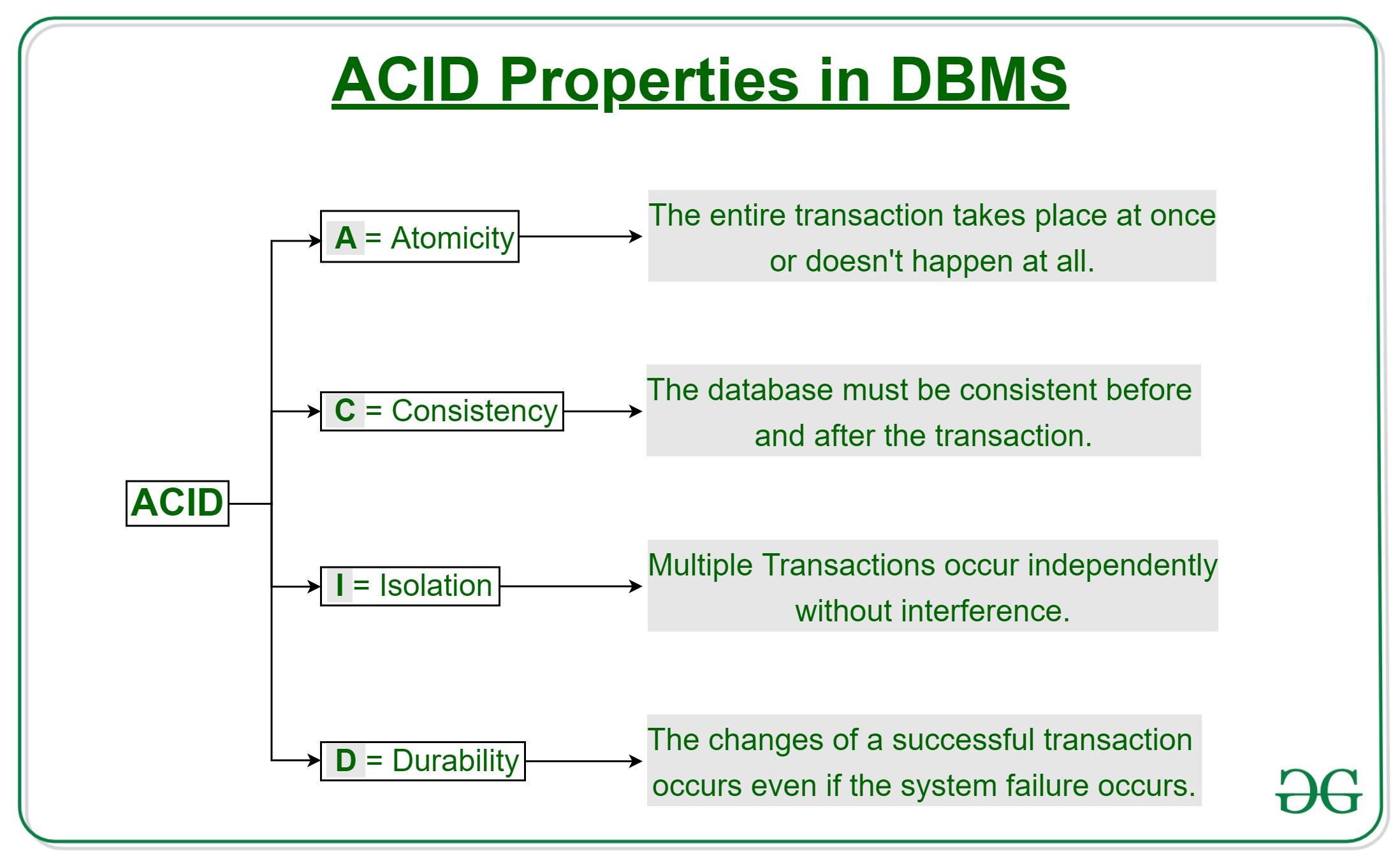
Each property works together to ensure data correctness even under:
- System crashes 💥
- Concurrent transactions ⚙️
- Network partitions 🌐
🏗️ Bonus: Distributed System Insight
In distributed databases, full ACID compliance is challenging due to CAP theorem constraints. Many systems use:
- 2-Phase Commit (2PC) for atomicity
- Consensus (Raft/Paxos) for durability
- Eventual Consistency to trade strict ACID for availability (BASE model)