This is the entry point for the whole HPC note set. Start here, then go deeper with the focused files. Together these notes cover both the platform/interview side (Slurm, MPI, storage, cloud) and the academic course side (architecture, parallel programming, parallel algorithms, performance theory — the material in NPTEL HPC / parallel computing courses, CMU 15-418-style courses, and CUDA courses).
🎬 These notes contain looping animations (in
animations/). They play automatically in the VS Code markdown preview (⌘⇧V), on GitHub, and on the published site.
The Full Map
| File | Covers |
|---|---|
| HPC-01-Fundamentals.md (this file) | definitions, taxonomies, workload shapes, scaling laws, glossary |
| HPC-02-Slurm-MPI.md | Slurm scheduling and MPI essentials |
| HPC-03-Storage-Networking-Operations.md | storage tiers, fabrics, cluster operations |
| HPC-04-Cloud-ParallelCluster.md | cloud HPC and AWS ParallelCluster |
| HPC-05-Interviews.md | interview frameworks and practice prompts |
| HPC-06-Computer-Architecture.md | pipelines, ILP, SIMD, caches, NUMA, coherence, roofline, interconnect topologies |
| HPC-07-Parallel-Programming.md | Pthreads, OpenMP deep dive, MPI advanced, CUDA/GPU, hybrid, PGAS |
| HPC-08-Parallel-Algorithms-Performance.md | PRAM, work-span, performance laws, parallel algorithms, load balancing, benchmarks |
| HPC.md | the interview-heavy master guide with Q&A, design patterns, and mock prompts |
Suggested reading order for course-style study: 01 → 06 → 07 → 08 → 02 → 03 → 04 → 05.
What is HPC?
High Performance Computing (HPC) is the use of aggregated compute resources — many cores, many nodes, accelerators, fast interconnects, parallel storage — to solve problems that are too large, too slow, or too time-sensitive for a single machine.
Typical workloads:
- weather and climate simulation
- CFD (computational fluid dynamics)
- molecular dynamics, quantum chemistry
- genomics and bioinformatics pipelines
- Monte Carlo simulation (finance, physics)
- seismic imaging, reservoir simulation
- AI/ML training at scale
- cryptanalysis, large-scale optimization
A Very Short History
| Era | Dominant design |
|---|---|
| 1970s–80s | vector supercomputers (Cray-1: one very fast pipelined vector CPU) |
| 1990s | massively parallel processors (MPPs), custom interconnects |
| 2000s | commodity clusters (Beowulf model): x86 nodes + Linux + MPI + Ethernet/InfiniBand |
| 2010s | multicore + GPU acceleration, petascale |
| 2020s | exascale (Frontier, Aurora, El Capitan), heterogeneous CPU+GPU nodes, cloud HPC |
The lesson of the history: performance stopped coming from faster single processors (power wall, end of Dennard scaling) and now comes almost entirely from parallelism.
Units and Peak Performance
- FLOPS = floating-point operations per second.
- GigaFLOPS (10⁹), TeraFLOPS (10¹²), PetaFLOPS (10¹⁵), ExaFLOPS (10¹⁸).
Peak (theoretical) FLOPS of a CPU node:
peak = sockets × cores/socket × clock (GHz) × vector width (elements) × FMA (2) × FMA unitsExample: 2 sockets × 32 cores × 2.5 GHz × 8 doubles (AVX-512) × 2 (FMA) × 2 units ≈ 5.1 TFLOPS double precision.
Real applications typically reach a small fraction of peak — memory bandwidth, communication, and serial sections dominate. That gap is what most of HPC engineering is about. See the roofline model in HPC-06-Computer-Architecture.md.
The Core Goal
HPC optimizes for:
- time-to-solution (strong scaling: finish one job faster)
- throughput (many jobs per day)
- capability (solve problems that fit nowhere else)
- efficient use of compute, memory bandwidth, network, and storage
HPC vs General Distributed Systems
| Dimension | HPC | General Distributed Systems |
|---|---|---|
| Goal | time-to-solution, throughput | availability, elasticity |
| Workload | batch, simulation, training | online serving, APIs |
| Communication | frequent, structured, latency-critical (MPI) | request/response, queues |
| Network | low-latency fabrics (InfiniBand, EFA), RDMA | standard Ethernet usually fine |
| Failure handling | checkpoint/restart | retries, replication, consensus |
| Scheduling | batch queues, gang scheduling | orchestration, autoscaling |
| State | large in-memory state per job | externalized state (DBs) |
Flynn's Taxonomy
Classifies architectures by instruction and data streams:
| Class | Meaning | Examples |
|---|---|---|
| SISD | single instruction, single data | classic sequential CPU core |
| SIMD | single instruction, multiple data | vector units (AVX), GPUs (per warp) |
| MISD | multiple instruction, single data | rare; some fault-tolerant/systolic designs |
| MIMD | multiple instruction, multiple data | multicore CPUs, clusters |
Two useful refinements:
- SPMD (single program, multiple data): the dominant programming style — every MPI rank runs the same program on different data. MIMD hardware, SPMD software.
- SIMT (single instruction, multiple threads): NVIDIA's GPU execution model — SIMD executed by threads grouped in warps.
Memory Architecture Classes
| Class | Description | Programming model |
|---|---|---|
| Shared memory (UMA/SMP) | all cores see one memory, uniform latency | threads: OpenMP, Pthreads |
| Shared memory (NUMA) | one address space, non-uniform latency by socket | threads + placement discipline |
| Distributed memory | each node has private memory | message passing: MPI |
| Hybrid | distributed nodes, shared memory + GPUs inside each | MPI + OpenMP + CUDA |
| PGAS | partitioned global address space (logical shared, physical distributed) | UPC, Coarray Fortran, Chapel |
Almost every real cluster today is hybrid: MPI across nodes, threads/GPUs within a node.
Core Terms
- Node: one machine in the cluster
- Core: execution unit inside a CPU
- Socket: physical CPU package; a node commonly has 1–2
- NUMA: non-uniform memory access — memory latency depends on which socket owns the memory
- Accelerator: GPU or other offload device attached to a node
- Rank: one MPI process
- Thread: execution context inside a process (OpenMP/Pthreads)
- Job: unit submitted to the scheduler
- Task: what the scheduler launches (often one rank per task)
- Partition/Queue: policy-managed pool of resources
- Wall time: real elapsed time limit for a job
- Interconnect/Fabric: the network connecting nodes
- Scratch: fast temporary parallel storage
- Checkpoint: saved application state used to restart after failure
Workload Shapes
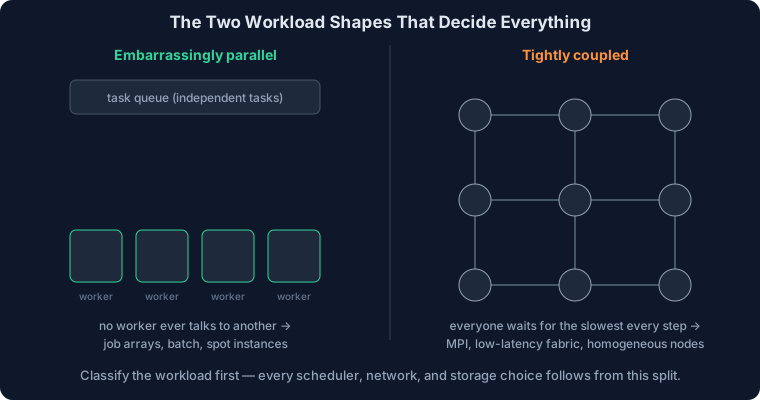
Embarrassingly parallel
Tasks are independent, no communication between them.
Examples: parameter sweeps, Monte Carlo, rendering, per-sample genomics.
Best fits: job arrays, cloud batch, spot capacity.
Tightly coupled
Tasks communicate frequently (often every iteration).
Examples: CFD, climate models, molecular dynamics, iterative linear solvers.
Best fits: MPI, premium network fabric, homogeneous nodes, shared scratch.
Hybrid
MPI across nodes plus threads or GPUs within nodes.
Examples: MPI + OpenMP weather codes, MPI + CUDA training/simulation.
Pipeline / workflow
Stages with data dependencies between different programs.
Examples: genomics pipelines, data assimilation. Best fit: workflow engines (Nextflow, Snakemake) on top of the scheduler.
Scaling Concepts
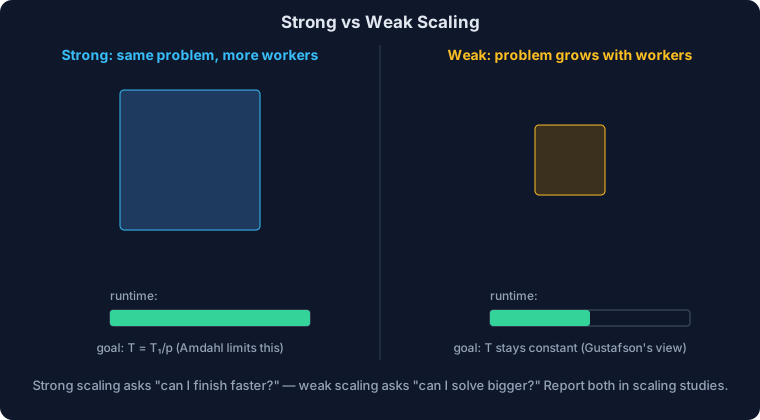
Strong scaling
Fixed total problem size, more resources. Question: does runtime go down proportionally?
speedup S(p) = T(1) / T(p) efficiency E(p) = S(p) / pStrong scaling always saturates: per-process work shrinks while communication and serial fractions do not.
Weak scaling
Problem size grows with resources (fixed work per process). Question: does runtime stay roughly constant? This is how the biggest simulations justify the biggest machines.
Amdahl's Law (strong-scaling limit)
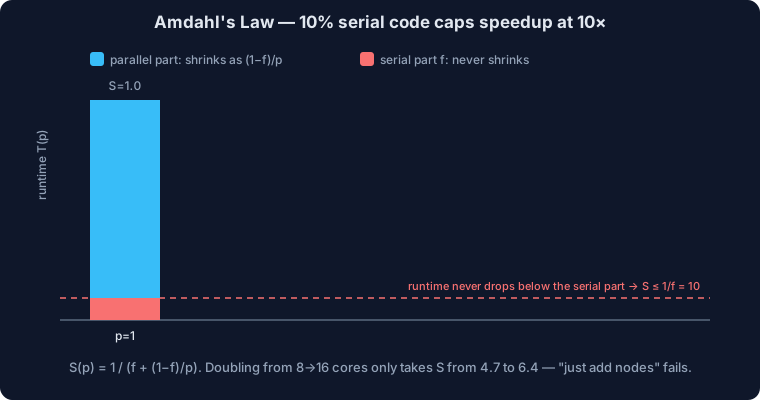
If a fraction f of the program is serial:
S(p) = 1 / (f + (1 - f)/p) S(∞) = 1/fExample: f = 5% serial → max speedup 20, no matter how many cores. Amdahl is why "just add nodes" fails.
Gustafson's Law (weak-scaling view)
Scale the problem with the machine and the serial fraction shrinks relative to total work:
S(p) = p - f × (p - 1)Bigger systems let you solve bigger problems, not only fixed problems faster.
Karp–Flatt metric (diagnosing real runs)
Given measured speedup S on p processors, the experimentally determined serial fraction:
e = (1/S - 1/p) / (1 - 1/p)If e grows with p, the bottleneck is parallel overhead (communication/imbalance), not inherent serial code. Great tool for "why did my job stop scaling" questions.
Isoefficiency (scalability of algorithms)
How fast must the problem size grow, as p grows, to keep efficiency constant? Slower required growth = more scalable algorithm. Details and examples in HPC-08-Parallel-Algorithms-Performance.md.
Sources of Parallel Overhead
Every gap between ideal and real speedup comes from:
- serial sections (Amdahl)
- communication (latency + bandwidth costs)
- synchronization (barriers, waiting on the slowest rank)
- load imbalance (uneven work per process)
- redundant work (recomputation, halo overlap)
- contention (memory bandwidth, network, filesystem)
Latency Numbers Worth Memorizing
| Operation | Approximate cost |
|---|---|
| L1 cache hit | ~1 ns |
| L2 hit | ~4 ns |
| L3 hit | ~10–30 ns |
| Local DRAM | ~80–100 ns |
| Remote-socket DRAM (NUMA) | ~130–200 ns |
| InfiniBand/EFA message latency | ~1–5 µs |
| TCP/Ethernet round trip (same DC) | ~50–500 µs |
| NVMe read | ~10–100 µs |
| Parallel FS small-file metadata op | ~ms |
The hierarchy spans ~6 orders of magnitude. Locality is the whole game.
The 5-Layer HPC Mental Model
- workload shape — independent, tightly coupled, GPU-heavy, or hybrid
- execution model — job arrays, MPI, OpenMP, CUDA, hybrid
- scheduler and policy — partitions, fairshare, QoS, backfill
- infrastructure — compute, fabric, storage tiers
- operations — monitoring, reproducibility, cost, multi-tenancy
Quick Interview Frame
When asked any HPC design question:
- classify the workload
- decide if it is independent, tightly coupled, GPU-heavy, or hybrid
- map that to scheduler, storage, and network
- explain reliability and cost tradeoffs
Where to Go Next
- Hardware and memory behavior → HPC-06-Computer-Architecture.md
- Writing parallel code → HPC-07-Parallel-Programming.md
- Algorithms and performance theory → HPC-08-Parallel-Algorithms-Performance.md
- Running jobs on clusters → HPC-02-Slurm-MPI.md
- Infrastructure → HPC-03-Storage-Networking-Operations.md, HPC-04-Cloud-ParallelCluster.md
- Interview prep → HPC-05-Interviews.md, HPC.md