This file covers the single-node hardware foundations that HPC courses (NPTEL "High Performance Computing", computer architecture segments of parallel computing courses) spend most of their time on: how a core executes instructions, how the memory hierarchy behaves, why NUMA and cache coherence matter, and how nodes are wired together. Performance tuning is impossible without this layer.
Why This Layer Matters
A cluster is only as good as what each core does per cycle. Most "parallel" performance problems are actually serial memory-behavior problems: cache misses, false sharing, NUMA misses, unvectorized loops. Fix the node first, then scale out.
Inside a Core: Pipelining
A processor overlaps instruction execution in stages (classic 5-stage: fetch → decode → execute → memory → writeback). With k stages, ideal throughput approaches 1 instruction/cycle with latency unchanged.
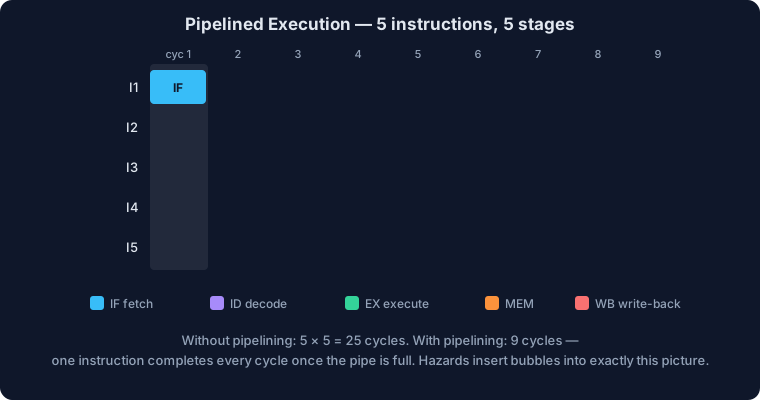
Pipeline hazards
| Hazard | Cause | Mitigation |
|---|---|---|
| Structural | two instructions need the same hardware unit | duplicate units, stall |
| Data | instruction needs a result not yet produced (RAW; also WAR/WAW) | forwarding/bypassing, stalls, register renaming |
| Control | branch outcome unknown when fetching next instruction | branch prediction, speculation |
- RAW (read after write) is a true dependence; WAR/WAW are name dependences removed by register renaming.
- A mispredicted branch flushes the pipeline — modern predictors are >95% accurate, but branchy inner loops still hurt.
Instruction-Level Parallelism (ILP)
- Superscalar: issue multiple instructions per cycle (4–6 wide today).
- Out-of-order execution: hardware reorders independent instructions around stalls; a reorder buffer retires them in order.
- Speculative execution: execute past predicted branches; squash on mispredict.
- ILP is limited by dependences, branch behavior, and memory latency — which is why architects turned to data-level parallelism (SIMD) and thread-level parallelism (multicore).
Why frequency stopped scaling
Dennard scaling ended: shrinking transistors no longer lowers voltage proportionally, so power (~ C·V²·f) becomes the limit — the power wall. Result: more cores at modest clocks instead of faster single cores. All modern performance growth is parallelism.
SIMD / Vector Units
One instruction operates on a whole vector register:
| ISA | Width | Doubles per op |
|---|---|---|
| SSE | 128-bit | 2 |
| AVX/AVX2 | 256-bit | 4 |
| AVX-512 | 512-bit | 8 |
| ARM NEON | 128-bit | 2 |
| ARM SVE/SVE2 | 128–2048-bit (scalable) | varies |
- FMA (fused multiply-add) does
a*b + cin one instruction → counts as 2 FLOPs. - Peak FLOPS depends on vectorization: scalar code on an AVX-512 machine leaves ~16× (8 lanes × 2 FMA) on the table.
- What blocks vectorization: loop-carried dependences, pointer aliasing, non-unit strides, branches in the loop body. See HPC-07-Parallel-Programming.md for how to help the compiler.
Simultaneous Multithreading (SMT / Hyper-Threading)
2+ hardware threads share one core's execution units to hide stalls. For memory-bound HPC codes SMT often hurts (cache contention), so HPC clusters frequently disable it or schedule one rank/thread per physical core.
The Memory Hierarchy
| Level | Size | Latency | Notes |
|---|---|---|---|
| Registers | ~KB | 0 cycles | compiler-managed |
| L1 cache | 32–64 KB/core | ~4 cycles | split I/D |
| L2 cache | 0.5–2 MB/core | ~12 cycles | per-core |
| L3 cache | 10s–100s MB | ~40 cycles | shared per socket |
| DRAM | 100s GB | ~100 ns | ~100–400 GB/s per socket |
| HBM (GPU/some CPUs) | 10s GB | similar latency, ~1–3 TB/s | bandwidth tier |
| NVMe / parallel FS | TB–PB | µs–ms | I/O tier |
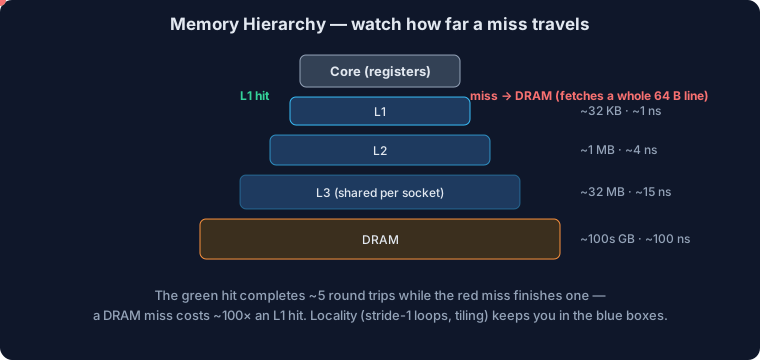
CPUs compute far faster than DRAM can feed them (the memory wall). Caches only work because programs have locality:
- Temporal locality: recently used data is reused soon.
- Spatial locality: neighbors of used data are used soon (cache lines are 64 bytes — you always fetch 8 doubles).
Cache Organization
- Data moves in cache lines (typically 64 B).
- Mapping: direct-mapped (1 place per line), N-way set-associative (N places), fully associative. Real caches: 4–16 way.
- Replacement: (pseudo-)LRU within a set.
- Write policy: write-back + write-allocate is typical (write-through is simpler but bandwidth-hungry).
The 3 Cs of cache misses (+1)
| Miss type | Cause | Fix |
|---|---|---|
| Compulsory | first touch of a line | prefetching, larger lines |
| Capacity | working set > cache | blocking/tiling, smaller working sets |
| Conflict | too many lines map to one set | padding, changing leading dimensions (avoid power-of-2 strides) |
| Coherence | another core invalidated the line | avoid sharing, avoid false sharing |
Cache-Friendly Programming (course staple)
Row-major C arrays: a[i][j] and a[i][j+1] are adjacent. Always make the innermost loop stride-1.
/* BAD: column order, stride N, one cache miss per element */
for (j = 0; j < N; j++)
  for (i = 0; i < N; i++)
    sum += a[i][j];

/* GOOD: row order, stride 1, one miss per 8 doubles */
for (i = 0; i < N; i++)
  for (j = 0; j < N; j++)
    sum += a[i][j];
Key loop transformations:
- Loop interchange: reorder loops for stride-1 access.
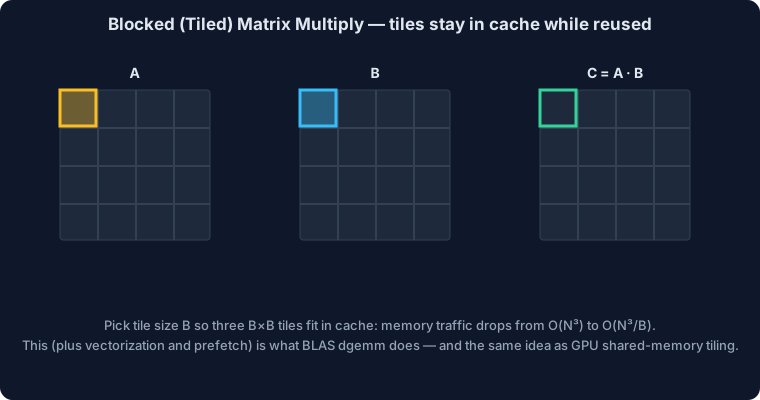
- Loop tiling/blocking: process B×B blocks that fit in cache — the classic fix for matrix multiply, turning O(N³) memory traffic into O(N³/B).
- Loop unrolling: fewer branches, more ILP, enables vectorization.
- Loop fusion: merge loops over the same data to reuse cached values (fission does the reverse to shrink working sets).
- Array of Structs → Struct of Arrays (AoS → SoA): if you only touch one field, SoA gives unit stride and vectorizes.
- Prefetching: hardware handles regular strides; software prefetch/streaming stores for irregular patterns.
Blocked matrix multiply sketch
for (ii = 0; ii < N; ii += B)
 for (jj = 0; jj < N; jj += B)
  for (kk = 0; kk < N; kk += B)
   for (i = ii; i < ii+B; i++)
    for (j = jj; j < jj+B; j++)
     for (k = kk; k < kk+B; k++)
      C[i][j] += A[i][k] * B[k][j];
Choose B so three B×B blocks fit in cache. In practice: call BLAS (dgemm) — it does this plus vectorization plus prefetching.
Virtual Memory and the TLB
- Programs use virtual addresses; hardware translates via page tables (pages typically 4 KB).
- The TLB caches translations (~1500 entries). A 4 KB-page TLB covers only ~6 MB — large scientific arrays thrash it.
- Huge pages (2 MB / 1 GB) expand TLB reach; HPC systems often enable transparent huge pages or explicit hugetlbfs for big arrays.
- Page faults and first-touch page placement matter for NUMA (below).
NUMA (Non-Uniform Memory Access)
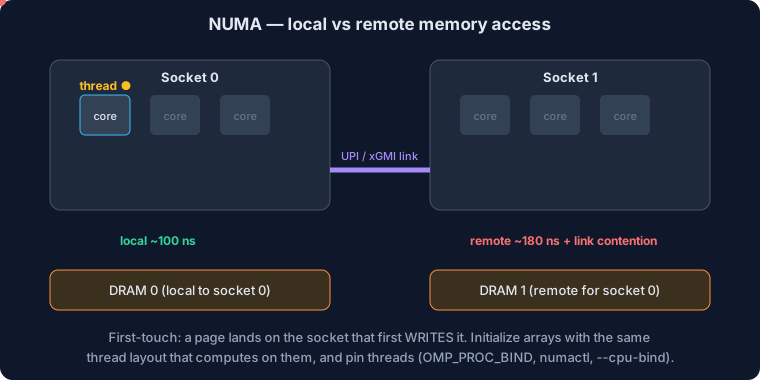
Each socket has its own memory controller; a socket's cores reach local DRAM faster (~100 ns) than the other socket's (~150–200 ns, over the inter-socket link).
Rules that matter:
- First-touch policy: a page is placed on the NUMA node of the core that first writes it. Initialize arrays with the same thread layout that will compute on them (a serial init loop puts everything on socket 0 and halves bandwidth for socket 1's threads).
- Bind threads and ranks (
OMP_PROC_BIND,numactl, Slurm--cpu-bind) so they don't migrate away from their memory. - One MPI rank per socket (or per NUMA node) with threads inside is a common hybrid layout precisely because of NUMA.
- GPUs and NICs also hang off a specific socket — GPU/NIC locality is NUMA too.
Inspect with numactl --hardware, lstopo, numastat.
Cache Coherence
With private caches, hardware must keep copies of a line consistent.
MESI protocol (know the states)
| State | Meaning |
|---|---|
| Modified | only this cache has it; dirty |
| Exclusive | only this cache has it; clean |
| Shared | multiple caches may have it; clean |
| Invalid | not usable |
A write requires exclusive ownership → other copies get invalidated → their next read misses (coherence miss). Extensions: MOESI, MESIF.
Snooping vs directory
- Snooping: every cache watches a shared bus for others' transactions. Simple; doesn't scale past a handful of cores.
- Directory-based: a directory tracks which cores hold each line and sends targeted invalidations. Scales to many cores/sockets; used in all modern multi-socket systems.
False sharing (classic exam + real-world bug)
Two threads write different variables that live on the same 64 B cache line → the line ping-pongs between cores in M state → huge slowdown with zero logical sharing.
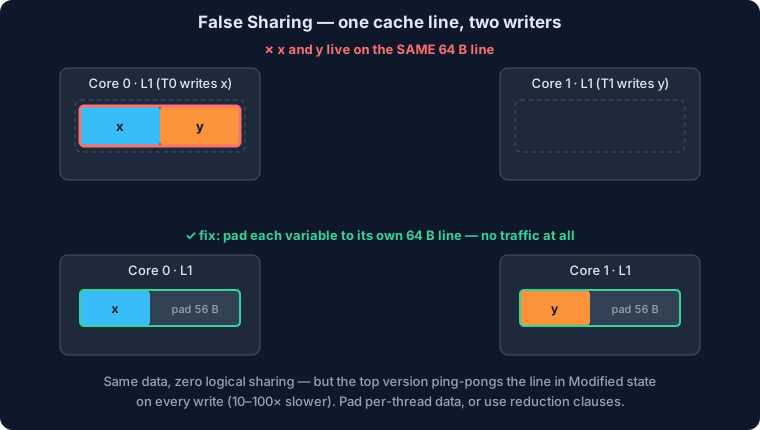
double partial[NTHREADS];          /* adjacent doubles share lines: BAD */

struct { double v; char pad[56]; } partial[NTHREADS];  /* pad to 64 B: GOOD */
Fixes: pad/align per-thread data to cache-line size, use thread-local accumulators, let OpenMP reduction handle it.
Memory Consistency (brief but examinable)
Coherence orders accesses to one location; consistency defines ordering across different locations.
- Sequential consistency: all threads see one global interleaving — intuitive, expensive; real CPUs don't give it by default.
- Relaxed models (x86-TSO: store buffering; ARM/POWER weaker): loads/stores can reorder → lock-free code needs fences/atomics (
std::atomic,#pragma omp flush). - Practical rule: use locks, atomics, and the constructs OpenMP/MPI provide; don't rely on plain loads/stores for synchronization.
The Roofline Model
Plots attainable FLOPS against operational (arithmetic) intensity I = FLOPs / bytes moved from memory:
attainable FLOPS = min( peak FLOPS , I × memory bandwidth )- Low I (STREAM triad ~0.08, SpMV ~0.1–0.25, stencils ~0.2–0.5): memory-bound — optimize data movement, not arithmetic.
- High I (dense matmul with blocking: grows with block size): compute-bound — vectorize, use FMA, use GPUs.
- The "ridge point" I* = peak/bandwidth tells you which side you're on (~5–10 FLOPs/byte on modern CPUs, similar on GPUs with HBM).
Measure achievable bandwidth with STREAM; this is the single most useful mental model for "why is my code slow."
GPU Architecture in One Section
(Programming details in HPC-07-Parallel-Programming.md.)
- A GPU is dozens–hundreds of SMs (streaming multiprocessors), each running thousands of lightweight threads.
- Threads execute in warps of 32 in lockstep (SIMT). Branch divergence within a warp serializes both paths.
- Latency is hidden by parallelism, not caches: when a warp stalls on memory, the SM switches to another warp instantly. You need massive oversubscription (10,000s of threads).
- Memory hierarchy: registers → shared memory (per-SM, user-managed, ~100 KB) → L2 → HBM (1–3 TB/s).
- CPU↔GPU transfers cross PCIe (~32–64 GB/s) or NVLink (~450–900 GB/s) — often the real bottleneck.
- Design consequence: GPUs win when there is abundant regular data parallelism and high arithmetic intensity; they lose on branchy, latency-sensitive, or small workloads.
Interconnection Networks
How nodes (and switches) are wired. Course-level metrics for a topology with p nodes:
| Metric | Meaning |
|---|---|
| Degree | links per node (hardware cost) |
| Diameter | worst-case hops (latency bound) |
| Bisection bandwidth | min bandwidth across any cut splitting the machine in half (all-to-all capacity) |
| Cost | total links/switches |
Topologies
| Topology | Diameter | Bisection | Notes |
|---|---|---|---|
| Bus | 1 | 1 link | doesn't scale; contention |
| Ring | p/2 | 2 | cheap, used inside chips and NCCL algorithms |
| 2D mesh | 2(√p−1) | √p | matches stencil codes |
| 2D/3D torus | halved vs mesh | 2√p | wraparound links; Blue Gene, Fugaku (6D) |
| Hypercube | log p | p/2 | elegant; degree grows with log p; basis of many algorithms |
| Crossbar | 1 | p/2 | ideal but O(p²) cost; inside switches |
| Fat tree / Clos | 2·levels | full (if non-blocking) | the standard for InfiniBand clusters |
| Dragonfly | ~3 | high | groups of routers, all-to-all between groups; Cray Slingshot |
- Fat tree fixes the tree's root bottleneck by making upper links fatter; "full bisection" means any half can talk to the other half at full rate. Clusters often build 2:1 or 4:1 oversubscribed fat trees to save cost — fine for embarrassingly parallel, painful for all-to-all (FFT, training).
- Routing: deterministic (dimension-order in meshes) vs adaptive (avoid congestion). Switching: store-and-forward (latency ∝ hops × message size) vs cut-through/wormhole (latency ≈ hops + message size) — modern fabrics are cut-through.
Simple communication cost model
T(message) = α + β × n (α = latency/startup, β = 1/bandwidth, n = bytes)α ≈ 1–2 µs and 1/β ≈ 10–40 GB/s on modern fabrics. Small messages pay α; that's why batching messages and avoiding many tiny sends matters. This α–β model is used throughout HPC-08-Parallel-Algorithms-Performance.md.
Interview / Exam Summary
- Performance = parallelism now; frequency scaling is dead (power wall).
- Know the 3 hazards, RAW vs WAR/WAW, why branch prediction matters.
- Peak FLOPS formula and why vectorization is mandatory to approach it.
- 3 Cs of misses; stride-1 access; tiling for matmul; AoS vs SoA.
- First-touch + binding for NUMA; false sharing and its padding fix.
- MESI states; snooping vs directory; coherence ≠ consistency.
- Roofline: compute-bound vs memory-bound via arithmetic intensity.
- Fat tree vs torus vs dragonfly; bisection bandwidth; α + βn cost model.